
PCOS blood testing · Bangkok

PCOS (PMOS)

Understand your hormones, periods and symptoms. Focused PCOS (PMOS) blood testing at BTS Punnawithi, Bangkok — 4,500 baht.

PCOS (PMOS): the short answer

PCOS (polycystic ovary syndrome) is a common hormonal and metabolic condition that can affect ovulation, periods, skin and hair, and is often linked to insulin resistance and a higher risk of type 2 diabetes. In May 2026, an international consensus published in The Lancet renamed it PMOS (polyendocrine metabolic ovarian syndrome) to reflect that it affects more than the ovaries. Both names are in use while the change is phased in through 2028. Kauri offers a focused blood panel to support assessment; results are interpreted alongside your symptoms and menstrual history.

Your PCOS (PMOS) blood panel

฿4,500

A focused hormone assessment—not a stand-alone diagnosis. The full marker guide below explains what each result contributes.

Book PCOS Testing

What's included in the panel?

  • Total testosterone
  • Free testosterone
  • Bioavailable testosterone
  • Albumin
  • Sex hormone-binding globulin (SHBG)
  • Anti-Müllerian hormone (AMH)
  • Thyroid-stimulating hormone (TSH)
  • Prolactin
  • DHEA-S (DHEAS)

What is PCOS, and why is it now called PMOS?

PCOS stands for Polycystic Ovary Syndrome. PMOS is the updated name for the same condition, not a different diagnosis. The new wording recognizes its endocrine, metabolic and ovarian features. You can have the condition without ovarian cysts, and people at any body weight can be affected.

When might PCOS testing be helpful?

Consider assessment for persistently irregular or missed periods, increased facial or body hair, acne, scalp-hair thinning, or difficulty conceiving linked to irregular ovulation. Not everyone has every symptom. Testing helps investigate a pattern rather than labeling a single symptom as PCOS.

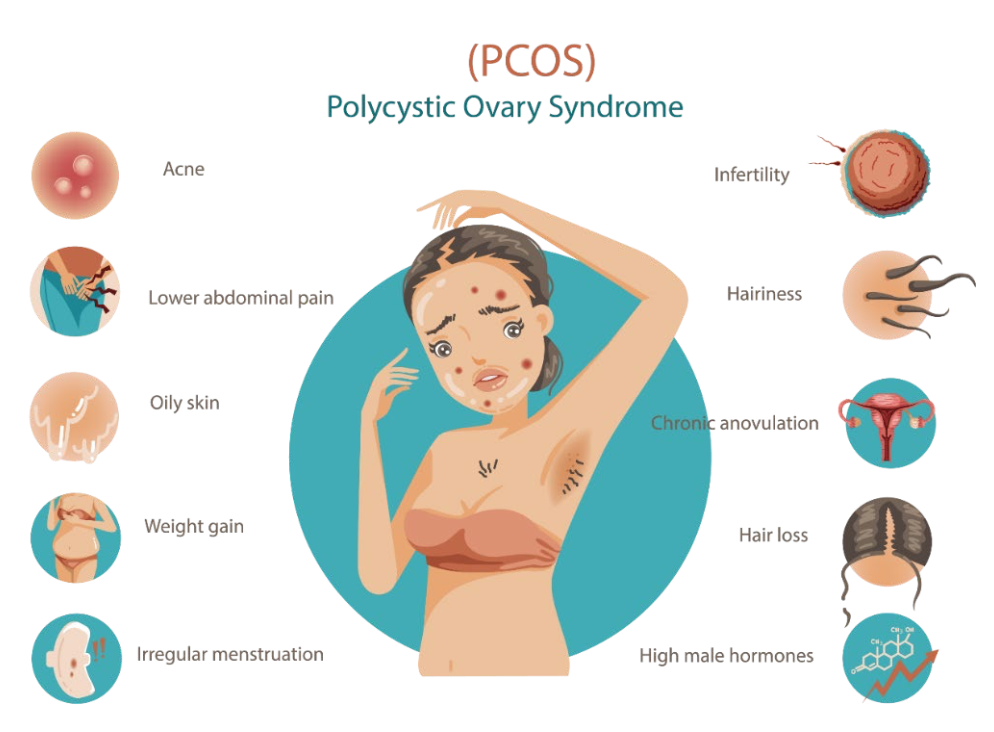
PCOS symptom illustration showing irregular periods, acne, excess hair growth and other possible features
Illustration of possible PCOS features, using the former name. Symptoms vary; infertility is not inevitable. Lower abdominal pain is not a defining PCOS feature and should be assessed on its own merits.

What does each PCOS blood marker tell you?

Total testosterone

  • What is it?

    Testosterone is an androgen that women also produce. Total testosterone measures both the protein-bound and free hormone in the blood.

  • Why is it important?

    Excess testosterone can contribute to acne, oily skin, increased facial or body hair and irregular periods.

  • High result

    May support a diagnosis of PCOS when considered with symptoms. Very high levels need assessment for other causes, including rare ovarian or adrenal tumours.

  • Low result

    May occur around menopause or with reduced ovarian function. Low testosterone is not a typical feature of PCOS.

Free testosterone

  • What is it?

    Free testosterone is the small proportion of testosterone that is not attached to proteins in the blood.

  • Why is it important?

    It helps assess androgen excess when total testosterone alone does not explain acne, excess hair growth or menstrual changes.

  • High result

    Can occur with PCOS, including when low SHBG leaves more testosterone unbound. Markedly high results require assessment for other causes.

  • Low result

    May reflect reduced testosterone production or high SHBG binding more of the hormone. It is not typical of PCOS.

Bioavailable testosterone

  • What is it?

    Bioavailable testosterone includes free testosterone and the portion loosely bound to albumin, which tissues can use.

  • Why is it important?

    It provides another way to assess how much testosterone is available to act on the skin, hair follicles and other tissues.

  • High result

    May support androgen excess associated with PCOS. It is interpreted with total testosterone, SHBG and symptoms.

  • Low result

    May occur with reduced ovarian function or changes in hormone-binding proteins, including high SHBG. It is not typical of PCOS.

Albumin

  • What is it?

    Albumin is a protein made by the liver. It carries substances in the blood and loosely binds some testosterone.

  • Why is it important?

    Together with total testosterone and SHBG, it helps calculate free or bioavailable testosterone. It is not itself a diagnostic test for PCOS.

  • High result

    Often reflects dehydration rather than a PCOS-related hormone change.

  • Low result

    May be associated with liver or kidney disease, inflammation or nutritional problems and needs interpretation in that context.

Sex hormone-binding globulin (SHBG)

  • What is it?

    SHBG is a protein made mainly by the liver that binds sex hormones, including testosterone.

  • Why is it important?

    It helps explain how much testosterone is free to act on tissues, even when total testosterone is within the laboratory range.

  • High result

    Usually means less testosterone is freely available. Possible causes include oestrogen-containing medicines, an overactive thyroid or some liver conditions.

  • Low result

    Can leave more testosterone free. It may occur with PCOS, insulin resistance, obesity or an underactive thyroid.

Anti-Müllerian hormone (AMH)

  • What is it?

    AMH is made by small follicles in the ovaries. It helps estimate ovarian reserve, rather than directly counting eggs or measuring their quality.

  • Why is it important?

    It can support PCOS assessment in adults and inform fertility evaluation, but does not diagnose PCOS or predict natural pregnancy by itself.

  • High result

    Often occurs in PCOS because the ovaries contain many small follicles. Interpretation depends on age and the laboratory method.

  • Low result

    May suggest reduced ovarian reserve, which can occur with ageing or ovarian insufficiency. It does not mean pregnancy is impossible.

Thyroid-stimulating hormone (TSH)

  • What is it?

    TSH is a hormone from the pituitary gland that signals the thyroid to make hormones involved in energy use and metabolism.

  • Why is it important?

    Thyroid disorders can cause irregular periods and symptoms that resemble PCOS, so TSH helps assess another possible cause.

  • High result

    May indicate an underactive thyroid (hypothyroidism), assessed alongside thyroid hormone levels.

  • Low result

    May indicate an overactive thyroid (hyperthyroidism); other thyroid results help clarify the cause.

Prolactin

  • What is it?

    Prolactin is a pituitary hormone involved in breast milk production that also affects ovulation.

  • Why is it important?

    Too much can suppress ovulation and cause irregular or absent periods, which can resemble PCOS.

  • High result

    Indicates raised prolactin, which has several possible causes, including medicines, stress or pituitary conditions. It is assessed separately from PCOS.

  • Low result

    Uncommon. Persistently low levels may warrant assessment of pituitary function, depending on symptoms and other results.

DHEA-S (DHEAS)

  • What is it?

    DHEA-S is an androgen made mainly by the adrenal glands, which sit above the kidneys.

  • Why is it important?

    It helps assess whether the adrenal glands are contributing to androgen excess, alongside testosterone and other findings.

  • High result

    Can occur in PCOS or adrenal conditions. Markedly high levels may prompt assessment for adrenal hyperplasia or, rarely, an adrenal tumour.

  • Low result

    May occur with ageing or reduced adrenal function. A low result alone does not diagnose adrenal insufficiency and is not typical of PCOS.

How is PCOS (PMOS) diagnosed?

In adults, diagnosis usually requires two of three features after other causes are excluded: irregular ovulation; clinical signs or blood evidence of excess androgens; and polycystic ovarian morphology assessed by ultrasound or, where appropriate, AMH. If irregular cycles and androgen excess are already present, ultrasound or AMH may not be needed for diagnosis. Blood tests support this assessment; no single result confirms the condition.

How should I prepare for the blood test?

Tell Kauri your last period date, usual cycle pattern, medicines, contraception and supplements. Hormonal contraception can change androgen and SHBG results; do not stop it yourself. We confirm sample timing and any fasting instructions before collection. Bring previous hormone results or ultrasound reports if available. You do not need an existing PCOS diagnosis to ask about testing.

What happens after the results?

The next step connects your results with your cycles, symptoms and goals, such as period regularity, skin concerns or pregnancy planning. Your clinician may discuss further assessment, lifestyle support or treatment options.

Patient questions

PCOS testing: common questions

How much does PCOS testing cost at Kauri?

The PCOS (PMOS) blood panel costs 4,500 baht. It includes total, free and bioavailable testosterone, albumin, SHBG, AMH, TSH, prolactin and DHEA-S. Ask the team about any separately requested services and result timing before booking.

Does a high AMH result mean I have PCOS?

Not on its own. Age, laboratory method and the wider clinical picture matter. AMH can support adult assessment, but it is not a stand-alone diagnostic test and is not recommended for diagnosing PCOS in adolescents.

Are free and bioavailable testosterone separate hormones?

No. They describe different fractions of the same hormone. Depending on the laboratory method, results may be measured or calculated from total testosterone, SHBG and albumin. Kauri can explain the method shown on your report.

Can I have PCOS without being overweight?

Yes. PCOS can occur across body sizes. Weight alone neither confirms nor excludes it; menstrual history, androgen features and the rest of the assessment are more informative.

Does PCOS mean I cannot get pregnant?

No. Irregular ovulation can make conception less predictable, but many people with PCOS become pregnant, naturally or with treatment. Tell your clinician if pregnancy is a goal so the next steps fit your plans.

Kauri Health Clinic · BTS Punnawithi

PCOS testing at BTS Punnawithi

Visit Kauri Health Clinic at BTS Punnawithi, 3063 Sukhumvit Rd, Bang Chak, Phra Khanong, Bangkok 10260. Open Tuesday–Saturday, 9:00–18:00. Book your PCOS (PMOS) blood panel or message us to discuss which tests fit your question.

Explore blood tests and health screening

Compare health screening packages, hormone tests, allergy blood tests and vitamin and micronutrient testing in one place.

View all blood tests and health screening
Chat on LINE